
by Maureen Li
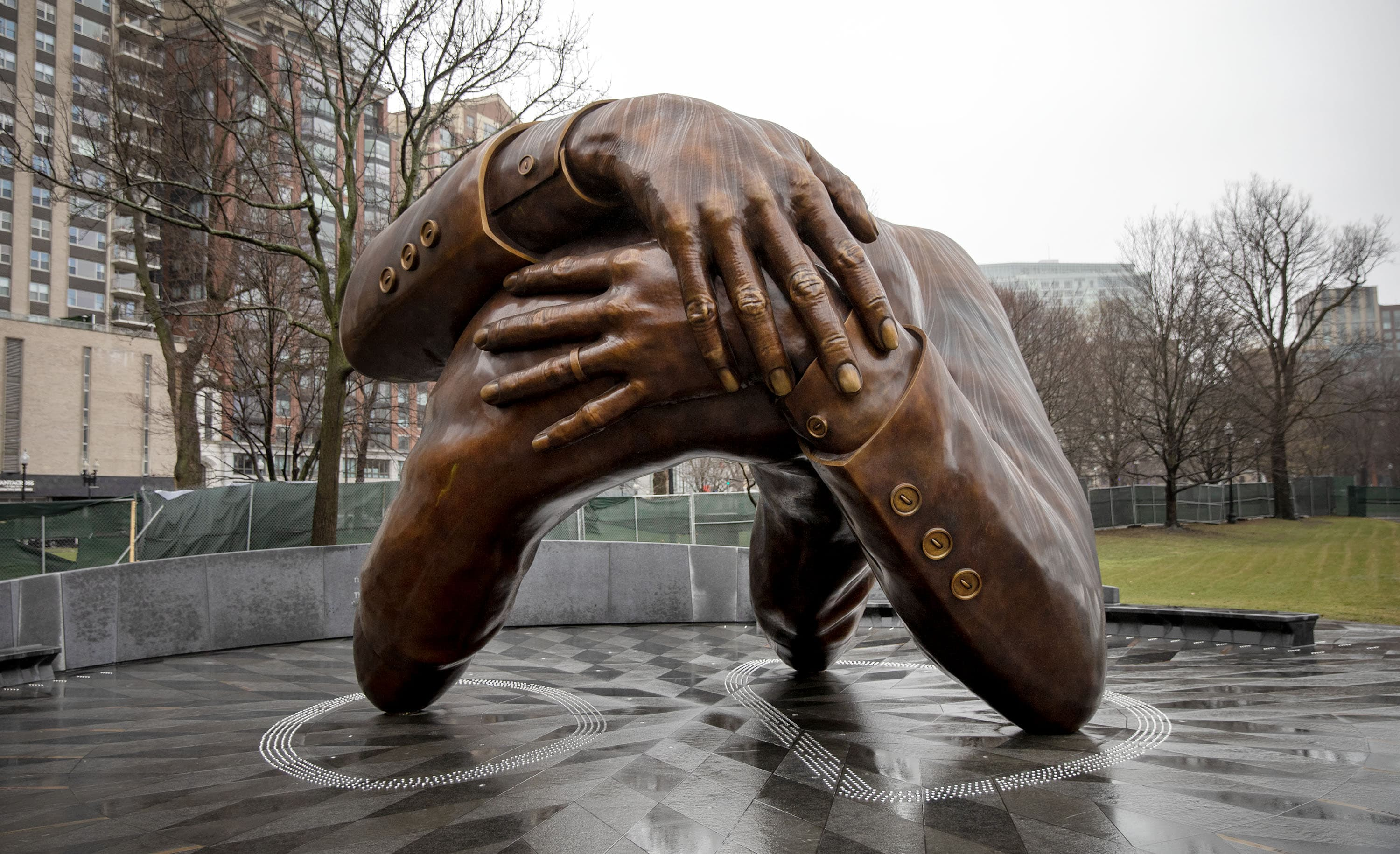
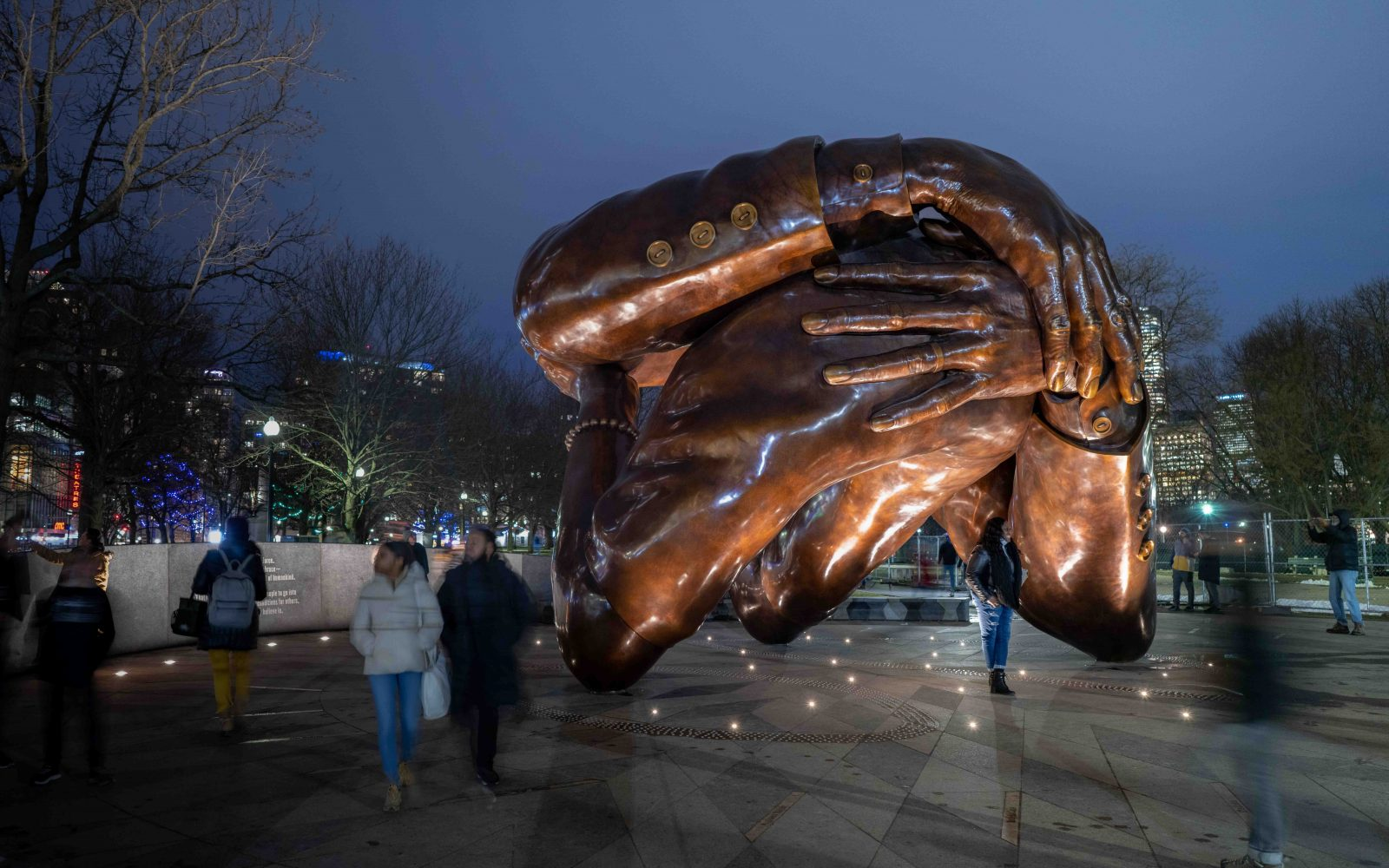
Last winter, Bostonians and commentators nationwide received a new statue at Boston Common with polarizing opinions. Some praised it for its groundbreaking nature of introducing Black national heroes into a historically white space that is the Boston Common. Some harshly criticized it for its inelegant form that can be easily misconstrued as inappropriate. This at the time controversial piece of public art is created by New York-based Black artist Hank Willis Thomas and MASS (Model of Architecture Serving Society) Design Group. The project started in 2017 under the Boston Foundation and Embrace Boston (formerly King Boston), an organization dedicated to establishing a memorial to Martin Luther King Jr. in Boston. In 2019, the committee chose the winning design after a round of proposals. The piece was installed in December 2022 and formally dedicated on a day of grand events and in between weeks of intense PR push in January 2023. Now as the Boston weather again starts to approach winter, I look back at this public art initiative and the thoughts I had around it at the time.
The artist choice is stellar in that both collaborators are deeply committed to social justice and good, but I wonder if the committee could have chosen a less flashy, more locally engaged group. First of all, yes, Hank Willis Thomas is well-known, perhaps less so among the general public, but definitely in the art circle, especially as one who works on and around social change. Alongside his artistic achievements, he is the co-founder of For Freedoms, an organization that supports artists with ideas for political engagement. His collaborator, MASS (Model of Architecture Serving Society) Design Group, is also a notable firm within the architecture industry known for design for social good, frequently working internationally – about half of their projects are in Rwanda and a few other East African countries. Thomas and MASS’ collaboration combines art and design for social change at the international, national, and Massachusetts level. However, I do wonder if it had been possible to commission an artist who has a more lived in and enmeshed experience with local history to collaborate on this piece, even if a big name like Hank Willis Thomas were still to be engaged. Given Boston’s unique history, it has its own set of racial issues that we need to continue to contend with. If Embrace Boston (the private non-profit that sponsored this statue, previously known as King Boston) were to truly push racial equity and justice forward, it would have been nice to engage more with local educational sites and organizations such as Museum of African American History, just a 6-minute walk away from the The Embrace site.
Speaking of local collaborators, although having worked in art consulting, I can’t pull from the top of my head a greater Boston area artist who makes large-scale (public) sculptures. Indeed, as one opinion piece about the housing shortage in Boston for artists on the Boston Art Review pointed out, the shortage and unaffordability of housing in Boston make it hard for artists to pursue large-scale projects, whether it is through a 2D or 3D medium. Not having the studio space for more spatially ambitious projects, most Boston-based artists I know and have worked with are limited to drawings, paintings, mixed media, and digital photography, pieces that are more manageable in a home studio. Those that do produce some form of sculpture, make works that are small-scale, and mostly from their home studio in the suburb. Then again, having conducted studio interviews with local working artists, I know some of them have a day job or a spouse who supports their work, and they mostly work in a space that’s not much larger than a bedroom, whether in a home basement, a designated office (read: tiny) in their home, or a rented studio in the city. If the King Boston Art Committee wanted to tap into local talents and history more, they could have engaged local artists that perhaps have family or personal ties to the history of Black folks in the city, teenagers from diverse backgrounds, etc. Or, maybe, dedicating an expensive statue involving lengthy efforts isn’t the best way to commemorate the Kings and extend their legacies for the city and the nation. Maybe more on-the-ground organizing would achieve the same goal better, given the money that the foundation had. After less than a year, many have already forgotten about the statue, despite the large waves of celebration and controversy it garnered at the time. Perhaps social programs instead of a one-off event could prove to be more long-lasting.
However, I have to defend The Embrace by saying that social change art projects should be allowed to flop, to be bland, to be controversial… just like all other public art projects. The fact that the phallic suggestions of the shape of The Embrace from some angles garnered so much attention, criticism, and hate, goes to show that there are not enough statues in this country on revolutionary Black figures, people of color figures, Indigenous figures, and all the historically under-represented, that any one attempt carries with it so much stake. In the context of lacking representation in art and in the social scene at large, any attempt is a good attempt. There is a saying in Chinese, 抛砖引玉 (”throwing out a brick to invite a jade”), meaning making a first attempt oneself so that others can go contribute good ideas to collectively build towards something great. The same goes for The Embrace. Some think it’s a brick, some think it’s jade, diamond, or broken glass. Everyone is entitled to their stance, but no matter what, I think it is a good start. When equipped with money and access like the Embrace Boston committee, one has the responsibility to use it well. What one does with their resources has direct impact. I hope as we keep fighting for social equity and justice, of different kinds, we keep in mind both short-term and long-term impacts of our choices and actions.
 MaxTalks
Nice article. There is a statue atop Philadelphia’s City Hall (which itself is an amazing piece of architecture and art) of William Penn, the founder of Pennsylvania. From a certain angle the statue appears, well, here’s the link, you decide:
https://www.phillyvoice.com/how-uh-big-was-william-penn/
Is it phallic, is it disgusting, should it be taken down. I’m sure there are people who have spoken out about it, and although the accepted rule is “perception is reality” it is not really reality. Art has meaning to different people from different perspectives depending on where/how you view it. The controversy around the piece in Boston illustrates that and lessons can be learned from shifting perspectives.
LikeLike
It looks like William’s Penn is showing…
I really appreciate the perspective. As someone who walked the Common nearly every day last year as the monument was being built, I see so many positives to its addition to the park. Maureen and I discussed the form while discussing the article, and I think something the Internet’s photos miss with “The Embrace” is that form changes dramatically depending on what angle you’re approaching the monument from. I would go far as to say you will see different shapes depending on your mood that day!
LikeLike